
英文原题
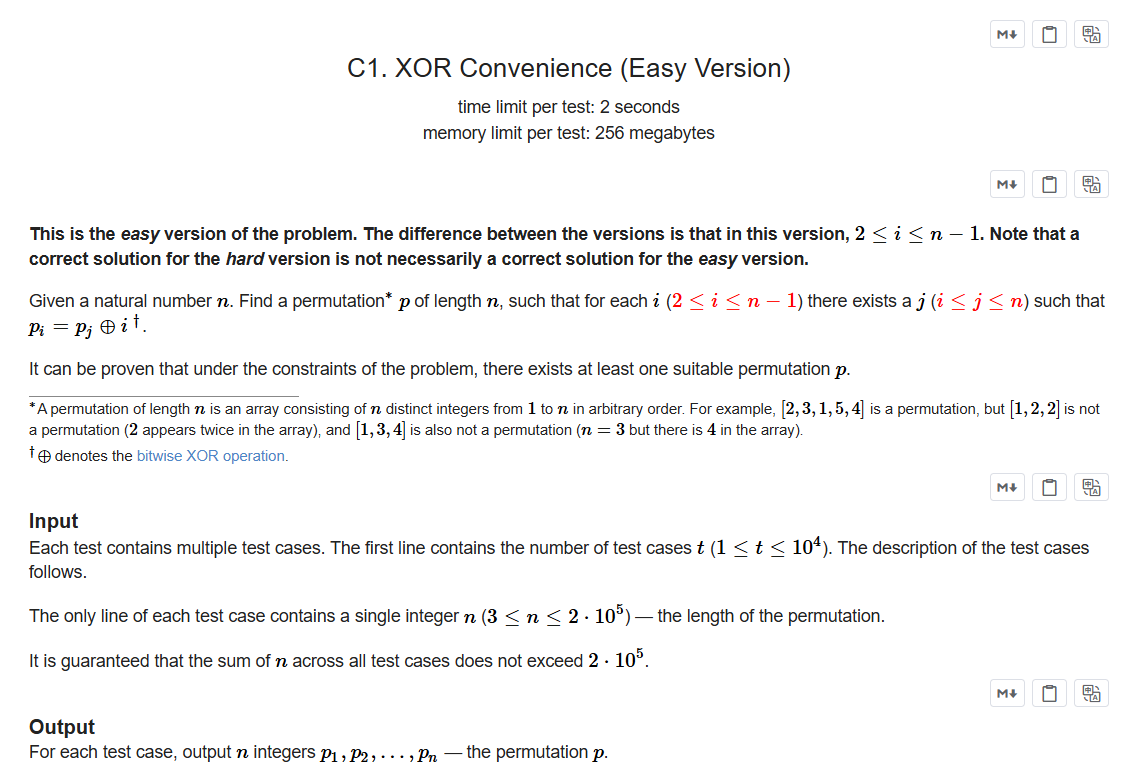
C1. XOR Convenience (Easy Version)
Time limit per test: 2 seconds
Memory limit per test: 256 megabytes
Input: standard input
Output: standard output
This is the easy version of the problem. The difference between the versions is that in this version, . Note that a correct solution for the hard version is not necessarily a correct solution for the easy version.
Given a natural number . Find a permutation∗ of length , such that for each there exists a such that .
It can be proven that under the constraints of the problem, there exists at least one suitable permutation .
∗A permutation of length n is an array consisting of n distinct integers from 1 to n in arbitrary order. For example, is a permutation, but is not a permutation (2 appears twice in the array), and is also not a permutation (n=3 but there is 4 in the array).
denotes the bitwise XOR operation.
Input
Each test contains multiple test cases. The first line contains the number of test cases . The description of the test cases follows.
The only line of each test case contains a single integer .
It is guaranteed that the sum of n across all test cases does not exceed .
Output
For each test case, output integers — the permutation .
If there are multiple solutions, you may output any of them.
Example
Input
2
3
6
Output
2 1 3
3 6 2 5 1 4
Note
In the first test case, the permutation is suitable since and .
In the second test case, the permutation is suitable, as:
中文翻译
C1. XOR Convenience (Easy Version)
每个测试点时间限制:2 秒
每个测试点内存限制:256 兆字节
输入:标准输入
输出:标准输出
这是该问题的简单版本。不同版本之间的区别在于,在本版本中满足 。请注意,针对困难版本的正确解法不一定适用于简单版本。
给定一个自然数 。请找出一个长度为 的排列,使得对于每个 ,都存在一个 满足 。
可以证明,在题目给定的约束条件下,至少存在一个符合要求的排列 。
∗长度为 的排列指的是一个由 n 个互不相同的整数组成的数组,这些整数的取值范围是 到 ,顺序可以任意。例如, 是一个排列,但 不是(数字 出现了两次), 也不是( 但数组中出现了 )。
表示按位异或运算。
输入格式
每个测试包含多组测试用例。第一行输入测试用例的数量 。接下来描述每组测试用例。
每组测试用例仅包含一行,输入一个整数 。
保证所有测试用例的 之和不超过 。
输出格式
对于每组测试用例,输出 个整数 —— 即满足要求的排列 。
如果存在多个可行解,你可以输出任意一个。
样例
输入
2
3
6
输出
2 1 3
3 6 2 5 1 4
说明
在第一个测试用例中,排列 是符合要求的,因为 ,且 。
在第二个测试用例中,排列 是符合要求的,原因如下:
C1. 题解
思路
题目要求对于所有的 ,必须存在一个 使得 。 利用异或的性质 ,原条件等价于 。注意到,当 为 时, 只能是 ,所以我们有以下思路:
由于我们需要构造任意一个满足条件的排列,我们可以尝试更贪心一点。 我们不妨让对于所有的 ,满足条件的 都固定为 。 我们希望构建一个排列,使得对于所有 ,都有: 为了方便计算,我们设 。 那么对于 ,中间的元素就确定为 。 我们需要检查按照 生成的中间段数字,再加上 ,最后缺了哪个数字,就把那个数字填给 。
异或 1 的性质:x 1 的作用是:如果 是偶数,则变为 。如果 是奇数,则变为 。它实际上是在相邻的偶数和奇数之间互换()。
情况1:n 是偶数
这是一个包含若干个完整偶奇对的序列。
对这些数进行 操作,只是组内互换,数值集合依然是 。
加上 ,目前用掉的数是 。
缺少的数是 n。所以令 。
情况2:n 是奇数
这个区间内的数是 以及单独剩下的偶数 。
前面的成对数字 后依然在集合内。
单独的 (偶数)操作后变为 。
所以中间段生成的数值集合是 。
加上 ,目前用掉的数是 。
缺少的数是 。所以令 。
方法
判断奇偶并填充开头元素:
若 n 为偶数,
nums先压入 。若 n 为奇数,
nums先压入 。
填充中间: 遍历 从 到 ,压入 。
填充结尾: 最后压入 。
输出: 打印
nums数组。
复杂度
时间复杂度: O(N)
空间复杂度: O(N)
代码实现
C++:
#include <iostream>
#include <vector>
using namespace std;
int main() {
ios::sync_with_stdio(false);
cin.tie(nullptr);
int t;
cin >> t;
while (t--) {
int n;
cin >> n;
vector<int> nums;
//偶数缺n,奇数缺n-1,压入数组中
if (n % 2 == 0) nums.push_back(n);
else nums.push_back(n - 1);
//构造中间部分,p[i] = i ^ 1
for (int i = 2; i < n; i++) {
nums.push_back(i ^ 1);
}
//末尾p[n] = 1
nums.push_back(1);
for (int i = 0; i < nums.size(); i++) {
cout << nums[i] << " ";
}
cout << endl;
}
return 0;
}